Dicehaven

Tabletop RPG Products and Games

Page 45 of 128

Multi-Genre RPGs and Thoughts on The Cypher System

There are a lot of setting-specific RPGs (D&D for Fantasy, Shadowrun for Cyberpunk, Traveller for Galactic Sci Fi) which are very cool. Many of the campaigns I’d like to run though are custom settings that in many cases are genre-mashups (Sci Fi Horror, Steampunk Supers, etc.). What systems currently on the market are best that support multiple genres?

Top Current Multi-Genre Systems

Here are my thoughts (personal opinions will vary of course). For our game club, I think the systems that will work best for us are in-print, have some mechanical depth (not complex math or rules per se, but deep character options to keep players interested as they level up).  This then would exclude games like GURPs and WEG d6 (out of print) as well as Apocalypse World Systems (small community hacks but no universal system in print).

Here then are my top choices for multi-genre games :

Tactical Systems (focus on combat)

  • Savage Worlds — Pinnacle’s system. Tends towards pulp-style games and longer, miniature oriented combat.
  • d100 — Basic Roleplaying or Mythras Imperative mixed with various monographs from Chaosium. Great focus in zoomed-in personal combat and high lethality. BRP is a bit dated and you’ll need to use Errata.

Narrative Systems (focus on story)

  • Fate Core — Great open system. A toolkit really, if you want to create a setting you’ll likely need to create a family of stunts and maybe use some community content.
  • Cortex Plus/Cortex Prime — Mature system used in licensed settings such as Marvel Heroic, Firefly, Battlestar Galactica, etc. New ‘Cortex Plus’ system will combine all the genre rules under one cover and will be out in April, 2018.
  • Cypher System — Gorgeous system from Monte Cook Games. Pretty expensive, but supports fantasy, science-fiction, horror, modern-day, and superhero in the core book. Expanded Worlds companion book adds genre support for post-apocalyptic, mythological, fairy tale, childhood adventure, historical, crime and espionage, and hard science fiction settings.
  • Genesys — Upcoming system from FFG will play like Star Wars but will support Fantasy, Steampunk, Weird War, Modern, and Sci Fi. Not a huge fan of the rules inconsistencies, excess crunch, and color-blind unfriendly aspects, but maybe they’ll fix some things.

Thoughts About the Cypher System

Here is a summary someone did on the differences between The Strange, Numenera, and The Cypher System

When it comes to comparing the three games:

Numenera – This was the first Cypher System game. It’s set in a far, far distant future where there have been many previous civilisations that have risen and gone over billions of years – some have fallen, some have moved on, some have transcended flesh in one way or another. Not all of the previous civilisations were even human. The Earth has been so thoroughly and repeatedly terraformed that the air and soil are full of nanotechnology and the place is full of the artefacts and sites of lost eras, the function of most of which is completely beyond the understanding of its current inhabitants. Unfortunately the setting doesn’t live up to the promise of that description I’ve just given. The central premise of the game is exploration and discovering the world’s wonders, but the game takes a firm line that nothing should ever be explained and things should always stay mysterious. This, unfortunately, makes the setting feel rather arbitrary and all style over substance. What little substance there is ends up being Generic Fantasy World #37, just with “ancient technology of unknowable purpose” standing in for “ancient magic”.

The Strange – The mechanics of this game are pretty much identical to those of Numenera, although the setting is very different. This is a game of parallel worlds. There’s a lot of background info about the extinct alien races and hypertechnology that caused things to be as they are, but when it comes down to it little of that is relevant to the average game, which is about exploring alternate worlds and dealing with the things that might come out of alternate worlds to threaten or invade ours. The idea is that most of these worlds are created from our fiction, so you can literally visit Middle Earth or Star Trek or Lovecraft Country or Jane Austen world – and, of course, inhabitants of those worlds can (temporarily) visit ours. Of course, the problem with fictional worlds is that they’re mostly copyrighted so the book can’t give you details about them. They get round this by having a couple of worlds that didn’t originate in fiction and most of the NPCs and organisations are related to those worlds instead of fiction-based ones. The game also has a neat mechanic where one aspect of your character (usually) changes to fit the world you’re currently in; so a scientist visiting the World of Warcraft might find that while there they have magical powers. As you can probably tell from my description, I much prefer this setting to the Numenera setting.

The Cypher System Rulebook – The third big product released for the Cypher System was this stand-alone rulebook. This uses the same rules as Numenera and The Strange, but presents them as a generic rule set without either of those settings. They actually have more options than either of the previous products, so I prefer to play in the setting of The Strange but using the rules from this book. Although this book doesn’t have a specific setting, it contains rules for adapting the Cypher System to a variety of genres; including horror, fantasy, sci-fi, and even superheroes. I’ve not tried the superhero options, but I’m told they work quite well for a particular level of superhero power. If you were only going to get one of the three books, I’d advise getting this one.

Source

I have yet to play it, and I’ve been turned off by their restrictive licensing (I’m a publisher) and costs (would my players buy $60 rulebooks?), but Jeff is running a mini-campaign which I’m unbelievably excited to try out. If it plays well and can be GM’d by mere mortals, I could see it fitting a great niche for some campaigns our game club wants to run!

And of course, I’m going to come out with my own multi-genre RPG at some point, but that won’t be robust and in-print until next year.


Ken Hite’s Review of ‘Basic Roleplaying’

Ken Hite (he’s worked on so many RPGs I’ve lost track; LUG Star Trek is the one I most recall) wrote a review of BRP (Chaosium’s d100 system-neutral game) a few years back. I’ve copied it here and highlighted a few points. I need to check out the ‘Passions’ mechanic.

Dry Bones Gonna Rise Up

Consider this the most comprehensive playtest review in history. I’ve probably logged more hours playing one or another form of Chaosium’s Basic Role-Playing engine — the core of Call of Cthulhu, RuneQuest, Nephilim, Stormbringer, Superworld, and Ringworld, to mention only the games that I’ve played with it — than every other RPG system combined. Including, I should add, using it as a “generic” engine for games from wild multiversal action to steampunk to Westerns to space opera to, well, occult horror investigation. I’ve also, for what it’s worth, written plenty of rules for it professionally, mostly for Nephilim and for Mongoose’s latest iteration of RuneQuest.
So I was glad to see that Sam Johnson and Jason Durall did a pretty darn good job of creating a core book for the game I’ve been running, off and on, for the last 25 or so years. Basic RolePlaying: The Chaosium Roleplaying System (399 pages, black-and-white softcover, $39.95) takes all those Chaosium core books and filters them down into one generic RPG system.

Surely everyone knows by now how BRP works: human character stats go from 3-18 (the new book offers point-builds as well as random rolls), skills go from 0% to 100% (the new book has rules for skills over 100% now), you roll percentile dice under your skill, and bang. Armor subtracts from damage, and you can get as crazy as you want with hit locations, but it’s still basically “d100 and a cloud of dust” with characters that are almost always gratifyingly fragile in combat. That, and the robust skills engine (this book’s skill list is a macedoine of Chaosium’s greatest hits), let the game explore other sorts of scenes besides fights. Magic? Depends — this book has superpowers, mutations, magic (a laRQ), sorcery (a la Stormbringer or CoC), or psionics (a la ElfQuest). Pick and choose, or mix and match. Gear, likewise; monsters, again likewise, taken from other Chaosium games and generified. Most of the specific Chaosium games have specialized mechanics and rules; most of them are somewhere in here, usually as optional rules. (The best? The passions mechanic from Pendragon. Use it.) But the core is the same game we’ve all been playing since 1978, when Steve Perrin looked in his white box and said “I’ll bet I could design better rules than this.”

In my experience, BRP remains excellently suited for any game in which combat is dangerous and something important reliably happens outside combat. It breaks down for demigods, but it breaks cleanly — there’s not enough rules to become cumbrous. BRP is also excellently suited for the modular attachment of any other, non-Chaosium game mechanics that you happen to like: at one time or another, I’ve added Ars Magica magic,GURPS advantages and disadvantages, and the old Marvel SuperHeroes superpowers (I’m not a fan of percentile superpowers) to BRP with less trouble than it took to type this sentence. (Not for the same game, I hasten to add. Although…) In short, it’s the cleanest, simplest, easiest generic system around. This is not to berate baroque (GURPS), complex (HERO), challenging (FUDGE) generic systems — but it’s nice to have a really good loaf of white bread, too.

And now it’s in one book, not 20.

(Source)

Caribdus Epilogue

Caribdus Epilogue


Caribdus will forever be changed by the actions of three young women. Their obsession with Blood Magic flooded an entire world nearly wiping out its population and threatened another: Earth.

The Crew that fought and died to stop them will go down in history as heroes.

The Maiden of the Mists, Mara, knew help would come from Earth and in her ethereal state did the best she could by pulling humans into Caribdus. In the final few months before the Hags defeat, the Maiden was forced to act more directly in order to aid the Crew. This caused the Hags to discover her and her portal. Their lust for power turned to planet Earth, but fortunately they were stopped.

Before her passing on, Mara connected with the Elemental Spirits and asked their help in restoring Caribdus. Water was not willing to relinquish control fully, but did allow Earth to expand itself. Thus balance was restored and the Elements were once again free and at peace.

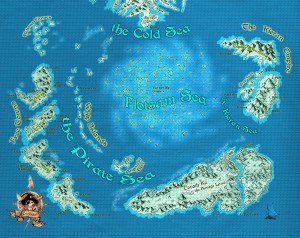
Dry land rose up all over the flooded world. Where Ograpog once stood, some of its waterlogged cities were risen up. Now a group of large islands stand in its place and green growth has started to rapidly take root. Where the Doreen homeland once stood a new archipelago has risen. All across what was once the Flotsam Sea there is now an opportunity for expansion and life.

The Atani, in a desperate attempt to aid the Crew and end the Hags, devised a clever use of the Elder Trees power to create a flying ship. Some say it was the spirit of Crow that encouraged its use and design, for it was the intelligence of the Elder Tree itself that first suggested it to the Atani people. However, not willing to risk the newly born Elder Tree any more than required, the Atani quickly landed their ship on the newly formed Ograpog archipelago and founded a new Grove. The trees are slow growing but have a firm grip on the earth now and a new Atani settlement is already prospering.

The Doreen, aided by the efforts of Daxson and Gop, claimed the new hunting grounds as their own. Using their prestige and gold, they were able to gather most of the remaining Doreen together to begin rebuilding their civilization. An unexpected ally was found in the Grael who surprisingly decided to join in partnership and stake a small claim in southern Caribdus.

The Kieran empire is an ever present threat, yet after their takeover of New Madrid a more formal negotiation between themselves and the East India Trading Company was established. Duckworth forced his hand and the new Ograpogian land is considered neutral. Neither party is able to stake a direct claim, it’s a land free to all people who wish to settle there. Most know that the Kieran empire they will not let this stand for long, but currently they are stretched too thin trying to cover their home waters and now New Madrid.

Baltimus is still the ever present hub of commerce. Edward Lazenby had a keen mind  to capitalized on the Crew success and is financing expeditions and settlements for the new land. The city is also known for being a unify presence in the region against outlaws and pirates. The Crew set the example of cooperation between cultures and cities, proving ultimately it could accomplish what large fleets could not. The standard is being used to draft a new treaty between the Free Towns.

Father Rodrigo’s work has been put to good use. The construction of a new cathedral is under way and Marium Rodrigo (his Abuela) is busying herself feeding the poor and helping those who need it find opportunity in the new land. A flood of Catholic refugees are finding their way to Baltimus and Rodrigo has his work cut out for him. Torquemada’s name has been appearing on whispered lips recently, but it is not know what is plans are or if he is even a threat still. After the destruction of the Hags by the hands of a Catholic Mage however, many left the Inquisition and joined the Jesuit order.

The Kraken Empire is learning to get by without magic with the help of Kaliferous. Research is ongoing to find the reproduction problems of the Scurillians and so far has been positive. A definite link between the seeping of elemental magic and reproduction has been found and that has most likely affected both races. Bracus and Equias have proved to be very valuable test subjects. Admiral Caspian is working to unify the Kraken again and rebuild their homeland. Now that the Sphere has been recovered,utilized and the Hag threat eliminated his people can now focus on long term settlement and research. The Kraken have found a good friend in the Doreen people and mutual cooperation is helping both races expand.

Jomba Town prospers and now holds a new patron, Mordecai, in high honor. His fight against both slavery and the beings of darkness has become legend. The Kaumatua (Eti’s Maori freedom fighters) have dedicated themselves to fighting slavery and the unique threats brought over from Earth- vampires, ghouls and other darker beings. They would follow the tradition of both Mordecai and Solomon Kane and purge the world of lingering darkness. On a lighter note: Captain Liam’s Superior Scotch has become a major export for the town and is proving popular across the sea.

As a tribute to the Crew and their courage a large statue has been erected in Jomba Town.

It depicts a man with a smooth round head and face so it favors no race.  He is wearing an early U.S. naval coat (Liam), a dagger in one hand(Daxson), strapped to his side a hooked blade which resembles part of a crab claws (Brachus), elemental depiction of wind and water swirling around it(Mordecai and Father Rodrigo), wings arched high on his back(Crow), and being crushed under its foot is an amorphic shape representing evil. In it’s free hand thrust high in the air is a functional lantern that kept blazing. This lantern represents hope for the hopeless, freedom for the enslaved, peace for the embattled, and stands as a reminder that just as it always burns so shall Jomba remain free of tyranny.  On a brass plaque there is written:

“In memory of those few who cared enough to dare to bring hope to the countless.  May your names be forever on our hearts.  Brachus, Crow, Daxson, Liam, Mordecai, Rodrigo”


Caribdus is changed and new adventures and challenges are over the horizon!


Sea Fever BY JOHN MASEFIELD

I must go down to the seas again, to the lonely sea and the sky,

And all I ask is a tall ship and a star to steer her by;

And the wheel’s kick and the wind’s song and the white sail’s shaking,

And a grey mist on the sea’s face, and a grey dawn breaking.

I must go down to the seas again, for the call of the running tide

Is a wild call and a clear call that may not be denied;

And all I ask is a windy day with the white clouds flying,

And the flung spray and the blown spume, and the sea-gulls crying.

I must go down to the seas again, to the vagrant gypsy life,

To the gull’s way and the whale’s way where the wind’s like a whetted knife;

And all I ask is a merry yarn from a laughing fellow-rover,

And quiet sleep and a sweet dream when the long trick’s over.


GM note:

This concludes 50 Fathoms campaign with the Dice Haven group which has run over two years and 35 sessions. When I picked up 50 Fathoms at my local gaming store I never would have imagined where it would take me.

I want to thank my entire group for their excellent roleplaying and years of fun, it’s been a pleasure creating this story with you. Your superior roleplaying and initiative helped shape a very fun world.  Also, thank you to Shane Hensley for the most excellent setting and plot point campaign.

I am sad to see the story end, but glad to see it ended mostly well for the Crew. There are some loose plot threads left hanging (I think any sandbox campaign would have a few) and Caribdus is forever changed. There are many more stories to tell in this new world, perhaps someday they will be told?


-Jeff Messina

6-22-17


« Older posts Newer posts »

© 2026 Dicehaven

Theme by Anders Noren — Up ↑