Tabletop RPG Products and Games

Author: Stan Shinn (Page 73 of 113)

Legends of Redmark: The Blood Arena

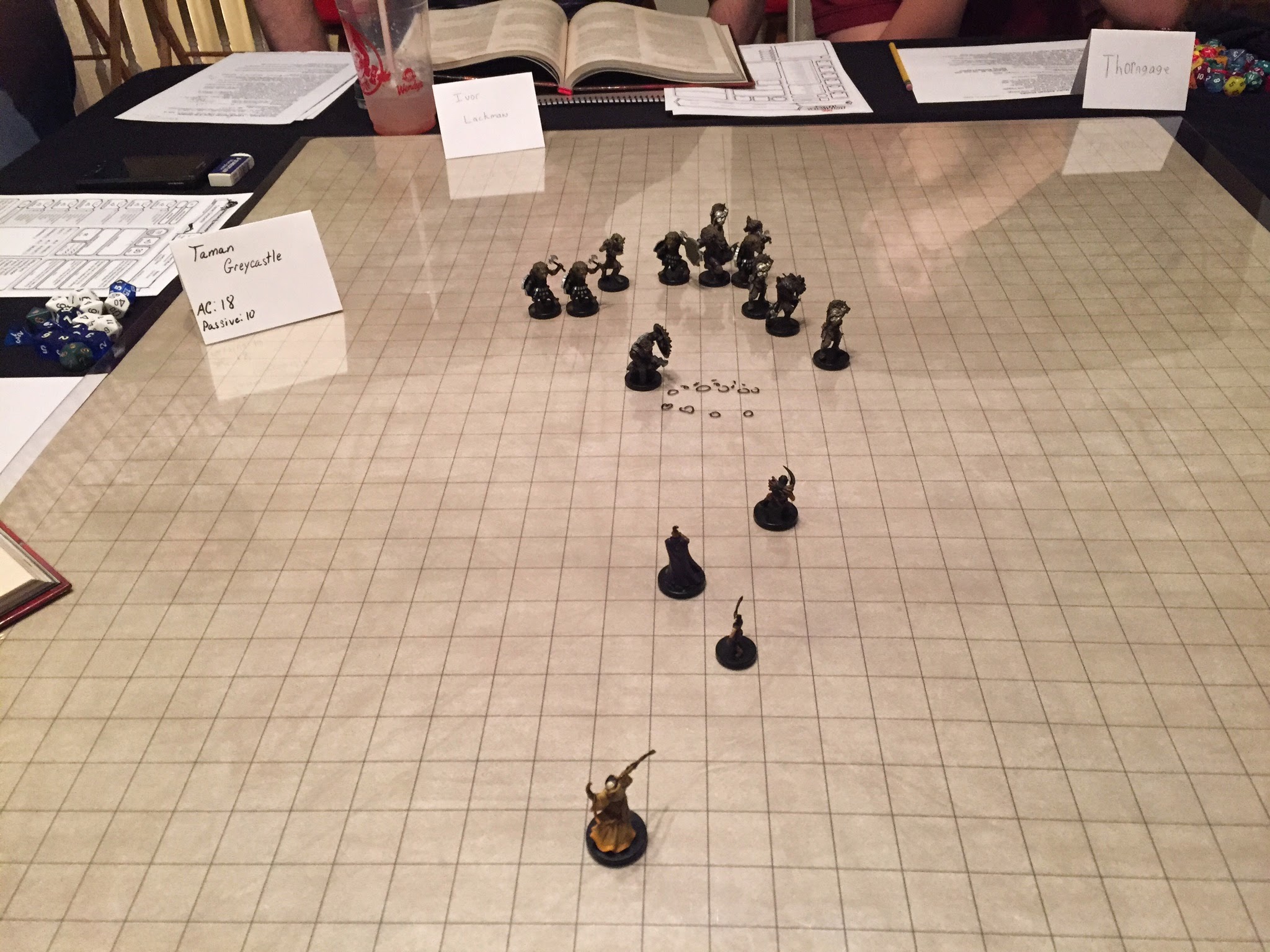
Had a great D&D game this last Saturday! Characters were at 6th level for this game and will be at 7th level next time we play.

Other news:

  • For out next game on Jan 31st we’ll spend most or maybe all the session building our characters and backstories and such for the mega-epic 50 Fathoms campaign. If we get done in a couple of hours I’ll run some Dreadfall.
  • Mason and Jeff got to talking about Fallout (a post-apocalyptic Sci Fi type game) and we decided that Mason (with maybe one game from Jeff) will run a mini-campaign, probably 6 session or so, of Fallout (using Savage Worlds rules). After Fallout ends, we’ll do 50 Fathoms. Or could be we just make it our ‘B’ campaign and run it when Jeff isn’t free or needs a break. Jeff and Mason will get back to us with plans 🙂
  • We talked about Stan putting together a one-shot or mini-series in the ‘B’ campaign veign with low-powered Supers at the high school or college age 🙂

Here’s some photos from the game:

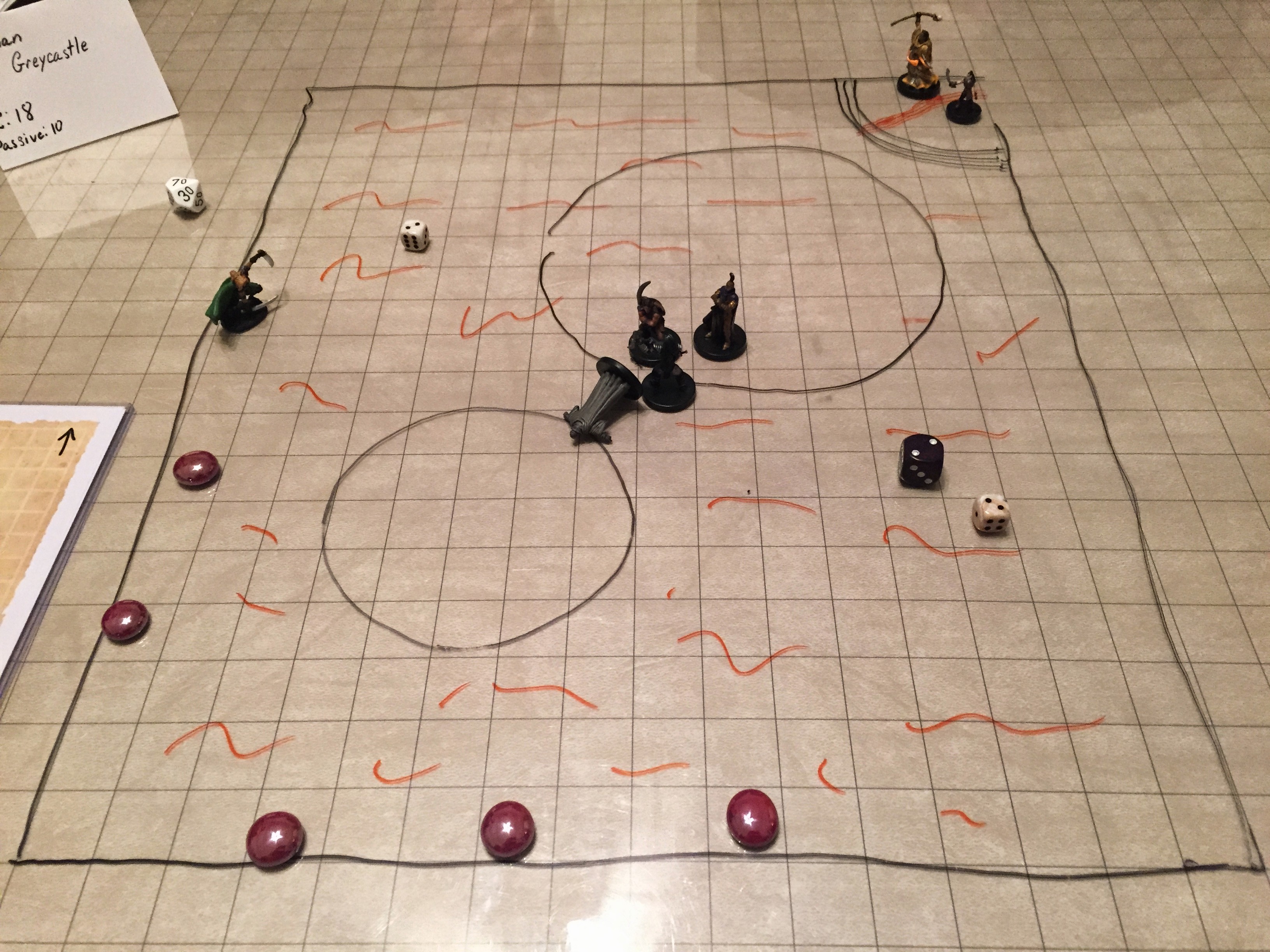
Race to get gear before your opponents  do!

Race to get gear before your opponents do!

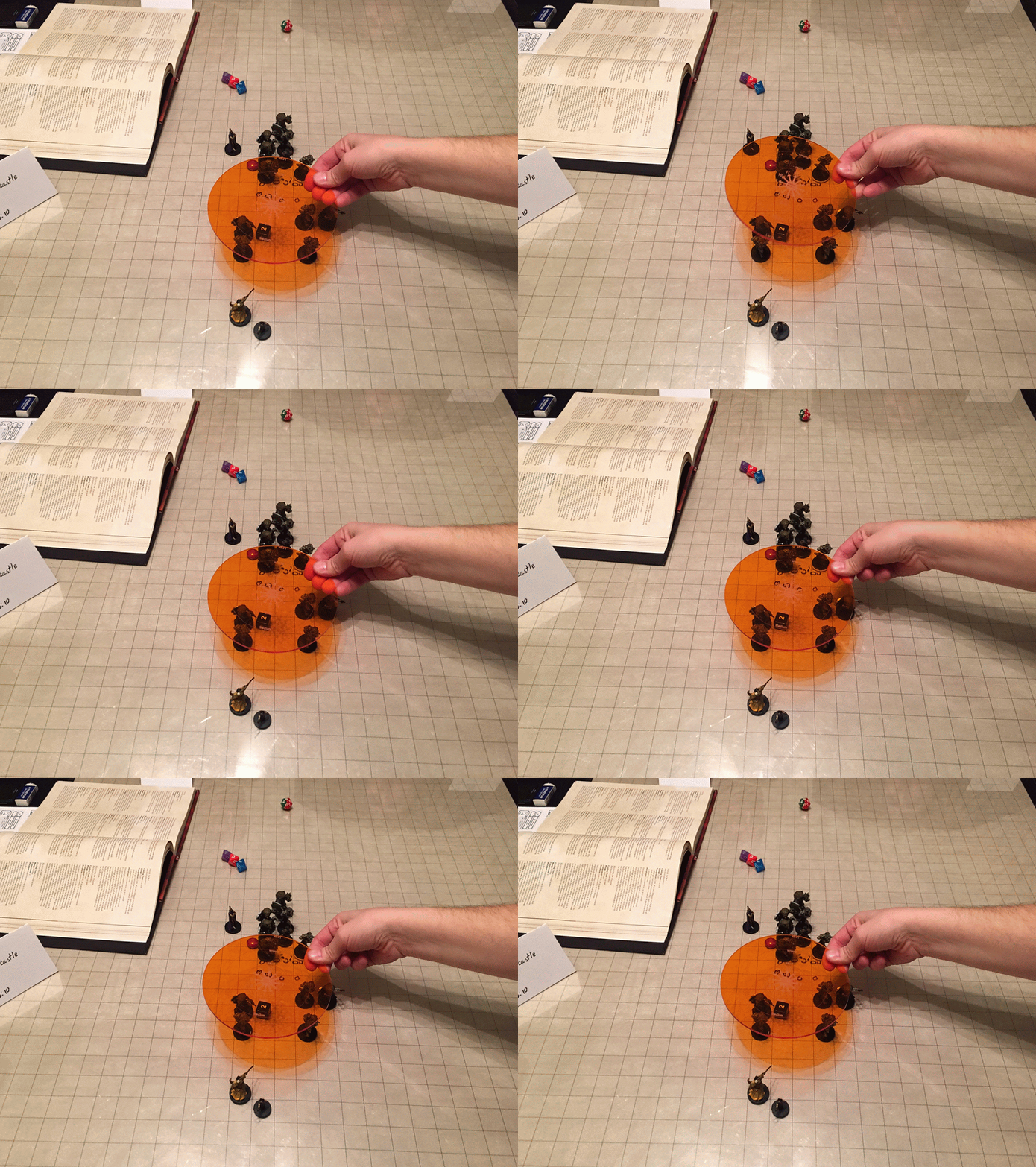
Using a burst template for area effects.

Using a burst template for area effects.

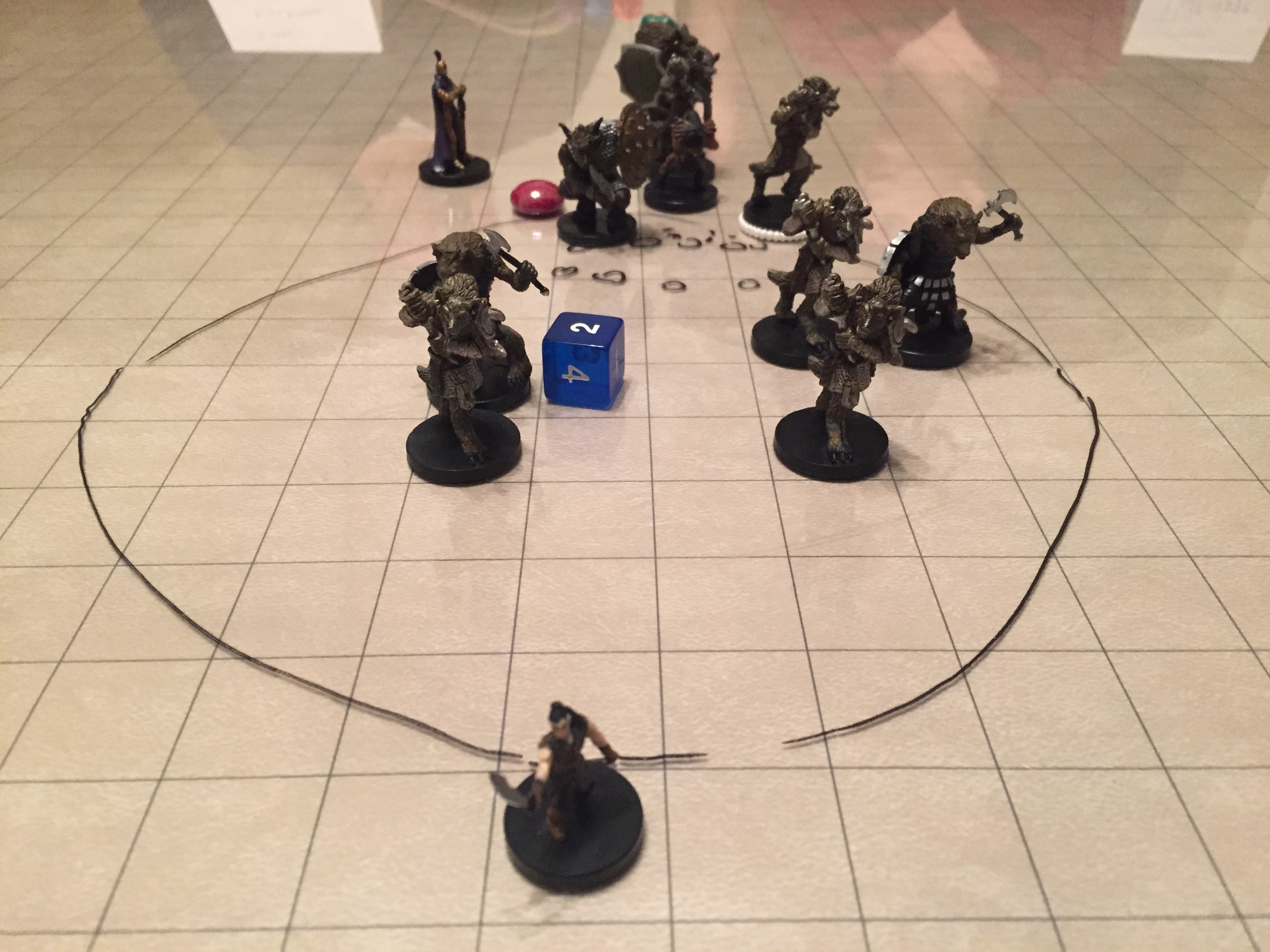
Close-up of a key battle.

Close-up of a key battle.

The final battle!

The final battle!

Lessons from Shane Hensley's Con Game: Initiative

After having reviewed how Shane Hensley set up his con game and his technique of using miniatures, I’ll now review how Shane handled initiative.

Initiative

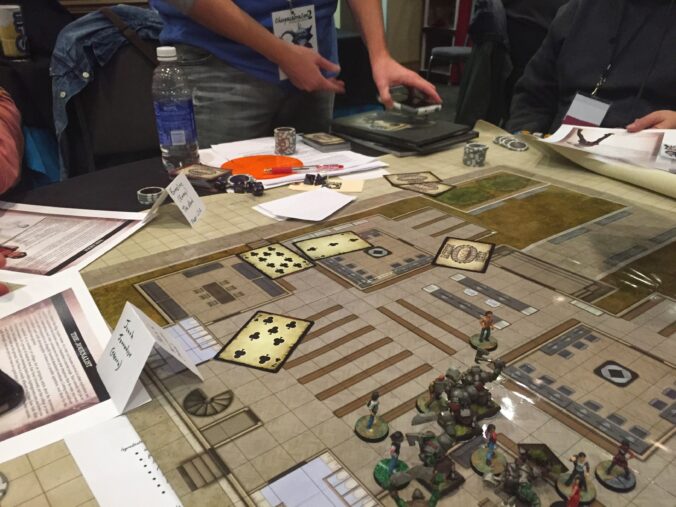
Dealt initiative cards

Shane used the normal sized Savage Worlds action card deck, not the over-sized style of cards. I’m a fan of over-sized cards since I have a hard time seeing the cards amidst all the clutter on the table. Not to worry — Shane used the technique of counting down initiative. He’ll simply start saying ‘Ace, King, Queen, 10…’ and counting down until people raise their hand or otherwise signal they have an initiative card that makes them up for their turn. If a couple of people raise their hand, Shane would adjudicate ties based on reverse alphabetical suit order per the standard Savage Worlds rules. After that player finished their turn Shane would glance at their card to see where the turn countdown had last left off, and resume a new coundown: “9, 8, 7…”.

Initiative card

Savage Worlds ‘Action Cards’ used for initiative — very Pulp-style!

Shane also used a technique of having the player flip a card over if that player was on hold to flag their held action. After the player finally acts later in the round he’d have the player flip the card back up to the regular side with suite and number.

On hold

An action card on hold

Another thing I noticed was Shane placing an NPCs card on a top corner of his GM screen. He could balance up to two cards up there and it made the cards easy to see and not get lost in the clutter of the table or in the clutter behind the GM screen.

I’ve seen some GM’s turn in the cards after their turn is over, but instead Shane waited until everyone completed their turn, then he asked for people to hand in their cards. At that point if a Joker had been drawn he’s shuffle the deck.

Dealt initiative cards

At the end of the turn we handed our cards back in.

Coming next: an analytics of Shane’s overall GM style and some of his in-game tricks!

Lessons from Shane Hensley's Con Game: Miniatures

As I mentioned on my prior post about Shane Hensley’s con game, during the game we had an area map from ETU on the table, but we ignored what was on the map and just used minis for general positioning and marching order.

At the very end he lifted up the ETU map and revealed a poster map of the final ‘boss fight’ scene; this was the only scene where we used a specific map. For most of the game it was theater of the mind action using the miniatures only for relative positions; he didn’t pull out minis for the bad guys until the final scene.

I personally like this technique since I find Theater of the Mind to be very immersive, though for tactical or ‘boss fight’ scenes where there is a lot going on in the environment and it’s hard to keep track of all characters movements and locations, I do see the benefit of miniatures.

Miniatures

Miniatures

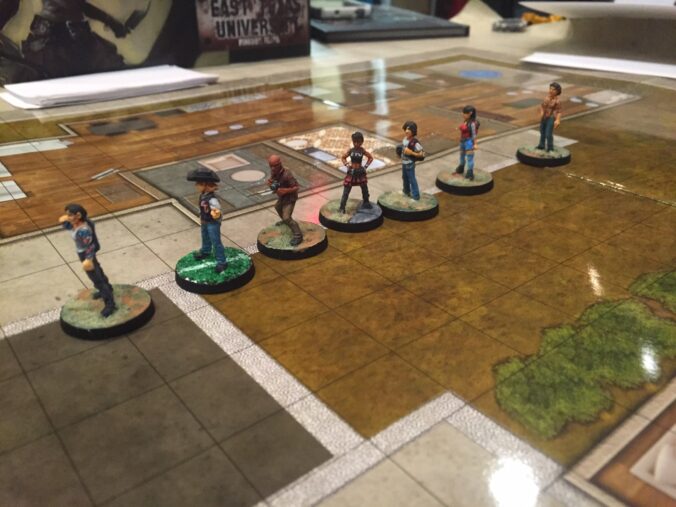
Shane used the time-old technique of establishing marching order by use of miniatures. This came in handy with an encounter with the sewers where the first PCs in line were first to encounter some traps and bad guys. This worked well.

Marching order

Marching order

The way Shane managed tracking conditions on miniatures was not exactly like I expected. One of the mantras in Savage Worlds is that you don’t track hit points — characters are either ‘up, down or off the table.’ In the games I’ve played in or run, the way we’ve implemented this was this:

  • Up = Character is not shaken and has no wounds
  • Down = Character is shaken (wounds were tracked by players or the GM on a note or by tokens placed next to the mini)
  • Off The Table = Character is incapacited

However, at least in this particular con game, here’s how Shane ran things:

  • Up = Character is not shaken and has no wounds
  • Up with Status Markers = Character is shaken and/or has wounds
  • Down = Character is Incapacitated

Why did Shane run it this way? I can’t say for sure, but here are some ideas:

  • Enemies were primarily college students who had been bewitched and transformed into monsters (Orcs). We were aiming to incapacitate, not kill, the enemy. So was helpful to have the minis there when they transformed back into students.
  • The combat was crowded, not leaving much room for mins to be down where they would take up 2+ squares.
  • Maybe this really is how most people run Savage Worlds miniatures these days and I just missed it!
Shaken status marker

Shaken status marker (normally completely under the mini, but I moved the mini so you can see the marker)

I’d love to hear any feedback on how you manage miniatures’ status during a game!

Lessons from Shane Hensley's Con Game: Table Setup

It was a great privilege that I was able to play in Shane Lacy Hensley’s East Texas University Savage Worlds game during ChupacabraCon 2 on January 10th, 2015 in Austin, Texas. I rate it as one of the top three con games I’ve ever played!

If anyone could be considered a ‘master of running a Savage Worlds game’ I think it would be Shane, given his role in authoring the game. Shane has a deep history in the roleplaying industry including doing work for or FASA, TSR, and West End, so I was very interesting in checking out his GM style.

I took copious notes during the game and snapped several pictures. This is the first of four articles documenting Shane’s GMing style as I observed it at this con game. I learned several techniques which I want to share with you! This article focuses on Shane’s table setup. In upcoming articles I’ll cover how Shane used miniatures, details on the way he managed initiative, and (perhaps of most interest) several specific GM techniques he used during the game.

First up: here’s how Shane set up the table and prepared props for the game.

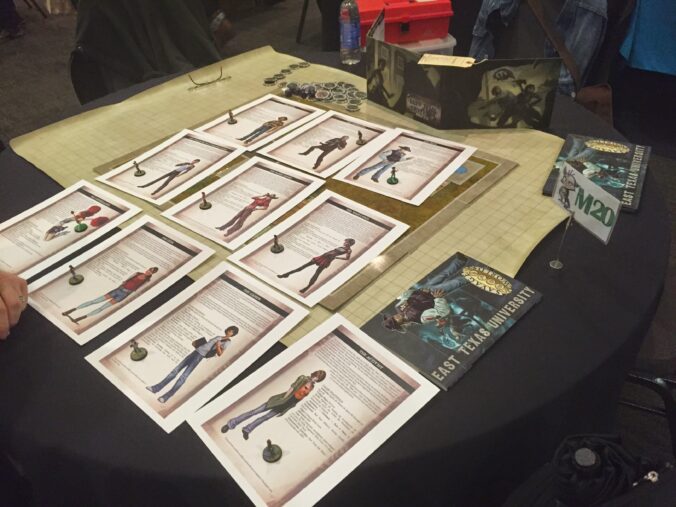
There were several pre-gens from the East Texas University setting. Character sheets were full color and printed on very heavy paper (or perhaps cardstock). Each pregen was essentially an nameless archetype which he said could be played as either gender (regardless of the gender shown on the character sheet or in the miniature). I played the “Jock” and named him “Zeke”. Each pregen had a mini-bio which was just long enough to inspire our own ideas on how to play the character.

Pre-gens with short bio and miniature

Pre-gens with short bio and miniature

Shane used the ETU GM screen which is tri-fold and just the right size for a round con-game table. Books and bennies sat outside the screen (although he took some bennies behind the screen at some point I believe where he could easily toss them to players).

After all players had selected a character, Shane handed out 3×5 cards and each player folded them over and wrote our character’s name on the ‘name tent’.

ETU 3 Panel GM Screen

ETU 3 Panel GM Screen and player name tents

After character introductions, Shane read aloud some prepared “boxed text” which gave us a description of recent events and set up the adventure hook. Immediately after that Shane announced that we all knew each other from previous Scooby-gang type adventures. We then took turns introducing our character and calling out their majors in college, and adding something interesting about them such as their Hindrances or Edges.

During the game we had an area map from ETU on the table, but we ignored what was on the map and just used minis for general positioning and marching order. At the very end he lifted up the ETU map and revealed a poster map of the final ‘boss fight’ scene; this was the only scene where we used a specific map. For most of the game it was theater of the mind action using the miniatures only for relative positions; he didn’t pull out minis for the bad guys until the final scene.

Also during the game Shane would pass out handouts with messages of documents, text messages or emails that we encountered from NPCs. Shane kept these handouts behind his GM screen.

Up next: more on Shane’s use of miniatures. Hint: it was a little different than I expected!
Redmark D&D Play Report (Nov. 24, 2014)

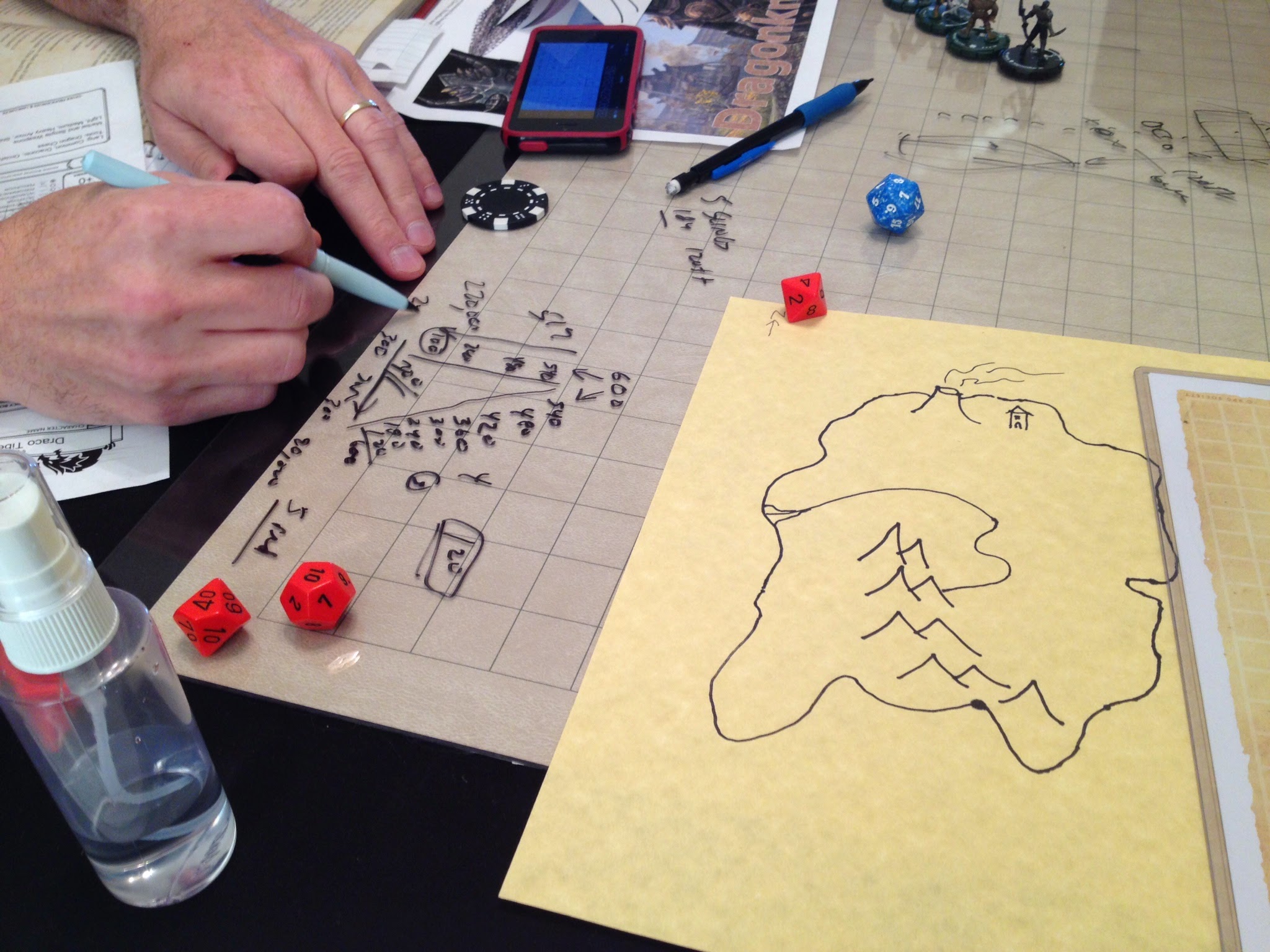
John does Trig to determine when enemy Apes in two groups will be in firing range!

John does Trig to determine when enemy Apes in two groups will be in firing range!

On Monday, Nov. 24th, we ran a game from 1pm to about 9:45pm. A great time was had by all! The mystery of the Wheel of Time was unraveled. Players survived a shipwreck, killed a bunch of intelligent apes (though a few juveniles escaped), evaded a gargantuan T-Rex, survived the mind games of siren-like lamprey men, puzzled through a few magic relics, and saved some castaways.

[su_box title=”Rewards”]
Characters Present:

  • Martines (Halfling Rogue) — Emory
  • Radgar (High Elf Wizard) — Robert
  • Maedir (Half-Elf Ranger) — Kevin
  • Draco (Human Fighter) — John
  • Quintos (Human Fighter) — Mason

Experience: Each player present received 625 XP for defeating monsters, and another 100 XP for great roleplaying.

Treasure: Each received 500 gp reward for solving the mystery. Also, you have the gold and ivory Lyre and special Glove of Loring the Lost. Neither are magical but both are historical treasures.

[/su_box]

And, for no reason I can think of, I’m posting a great quote from the DMG (available Friday at Madness I think):

[su_quote cite=”Dungeon Master Guide” url=”http://www.enworld.org/forum/content.php?2087-The-DMG-Disclaimer-Contains-Some-Secret-Useful-Advice!#.VHYxPytdWCo#ixzz3KDAFY9CK”]Disclaimer: Wizards of the Coast does not officially endorse the following tactics, which are guaranteed to maximize your enjoyment as a Dungeon Master. First, always keep a straight face and say OK no matter how ludicrous or doomed the players’ plan of action is. Second, no matter what happens, pretend that you intended all along for everything to unfold the way it did. Third, if you’re not sure what to do next, feign illness, end the session early, and plot your next move. When all else fails, roll a bunch of dice behind your screen, study them for a moment with a look of deep concern mixed with regret, let loose a heavy sigh, and announce that Tiamat swoops from the sky and attacks.[/su_quote]

« Older posts Newer posts »

© 2026 Dicehaven

Theme by Anders Noren — Up ↑